OpenAI's GPT-5.6 Series: A New Era in Language Models
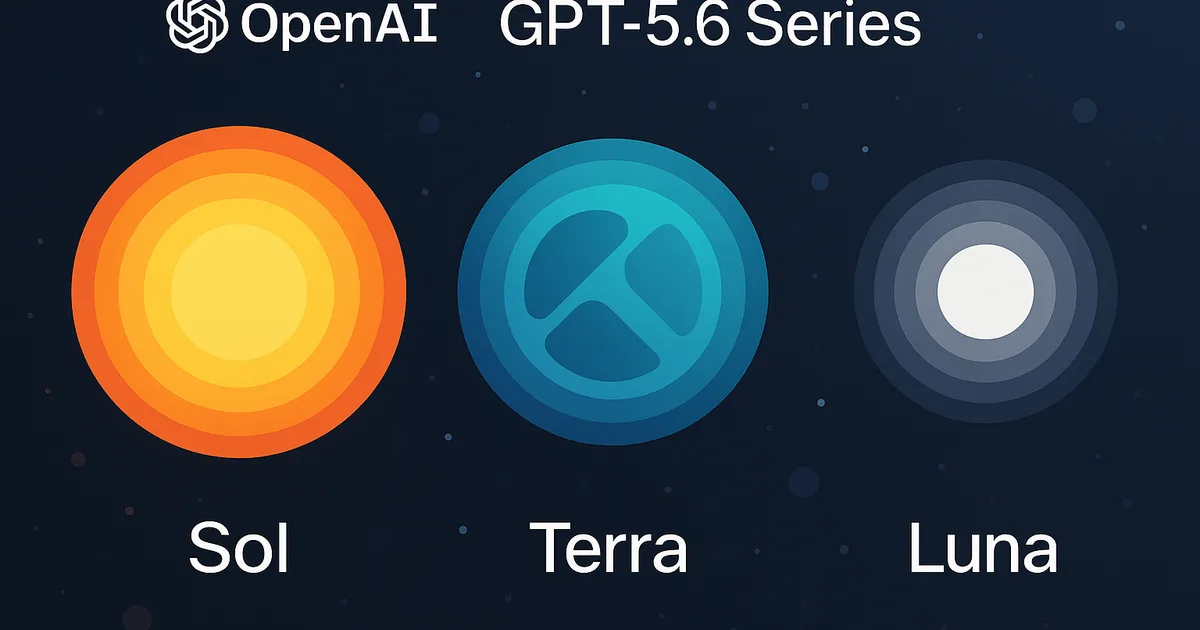
OpenAI's GPT-5.6 series introduces three models—Sol, Terra, and Luna—each tailored for specific tasks, marking a significant advancement in AI capabilities.
Get the daily AI & tech briefing.
OpenAI's GPT-5.6 Series: A New Era in Language Models
OpenAI has unveiled its latest suite of language models, the GPT-5.6 series, comprising three distinct models: Sol, Terra, and Luna. Each model is designed to excel in specific domains, offering tailored solutions for diverse applications. This release signifies a pivotal moment in AI development, emphasizing specialization and efficiency.
Sol: The Flagship Model for Complex Reasoning and Code Tasks
Sol stands as the flagship of the GPT-5.6 series, engineered to handle complex reasoning and coding tasks with unparalleled proficiency. It has achieved state-of-the-art performance on benchmarks like Terminal-Bench, showcasing its advanced capabilities. Sol introduces new "max" and "ultra" modes, allowing users to select performance levels that best suit their needs. This flexibility ensures that Sol can adapt to various computational requirements, making it a versatile tool for developers and researchers alike.
Terra: Optimized for Natural Language Understanding and Generation
Terra is tailored for tasks requiring deep natural language understanding and generation. It excels in applications such as content creation, translation, and conversational AI. By focusing on linguistic nuances and contextual relevance, Terra delivers outputs that are both coherent and contextually appropriate. This specialization makes it an invaluable asset for industries relying on high-quality text generation and interpretation.
Luna: Designed for Real-Time Interaction and Low-Latency Applications
Luna is crafted for real-time interactions, emphasizing low-latency responses without compromising accuracy. It is ideal for applications like customer support chatbots, virtual assistants, and interactive gaming. Luna's architecture prioritizes speed, ensuring seamless user experiences in scenarios where promptness is crucial. This model addresses the growing demand for responsive AI systems in dynamic environments.
Enhanced Safety Measures and Staged Rollout
OpenAI has implemented robust safety protocols in the GPT-5.6 series, underscoring the importance of responsible AI deployment. The models are being introduced through a staged rollout, coordinated with regulatory bodies to ensure compliance and mitigate potential risks. This approach reflects OpenAI's commitment to ethical AI practices and the prioritization of user safety.
Implications for the AI Industry and Future Developments
The introduction of the GPT-5.6 series marks a shift towards specialized AI models, moving away from the one-size-fits-all paradigm. This trend allows for more efficient resource utilization and improved performance in targeted applications. As AI continues to evolve, we can anticipate further diversification of models, each designed to meet specific industry needs and challenges.
Practical Applications and Industry Adoption
Industries across the board are poised to benefit from the GPT-5.6 series. For instance, Sol's capabilities can enhance software development processes, Terra can revolutionize content creation and translation services, and Luna can improve customer engagement through responsive virtual assistants. The tailored nature of these models ensures that businesses can integrate AI solutions that align closely with their operational requirements.
Comparative Analysis: GPT-5.6 Series vs. Previous Models
To illustrate the advancements in the GPT-5.6 series, consider the following comparison:
Model | Specialization | Key Features | Performance Benchmarks |
|---|---|---|---|
GPT-4 | General-purpose | Broad applicability | Standard benchmarks |
GPT-5.6 Sol | Complex reasoning, coding | "Max" and "ultra" modes | State-of-the-art on Terminal-Bench |
GPT-5.6 Terra | Natural language tasks | Contextual relevance | Superior linguistic performance |
GPT-5.6 Luna | Real-time interaction | Low-latency responses | Enhanced user engagement |
This table highlights the targeted improvements and specialized functionalities introduced in the GPT-5.6 series, demonstrating OpenAI's commitment to advancing AI technology in meaningful and practical ways.
FAQ
What are the main differences between Sol, Terra, and Luna?
Sol is optimized for complex reasoning and coding tasks, Terra excels in natural language understanding and generation, and Luna is designed for real-time interactions with low-latency responses.
How does the staged rollout of GPT-5.6 ensure safety?
The staged rollout involves coordinated efforts with regulatory bodies to monitor and address potential risks, ensuring compliance with safety standards and ethical guidelines.
Can businesses integrate multiple models from the GPT-5.6 series?
Yes, businesses can integrate multiple models to leverage their specialized capabilities, tailoring AI solutions to their specific operational needs.
What industries stand to benefit most from the GPT-5.6 series?
Industries such as software development, content creation, customer service, and interactive entertainment can significantly benefit from the specialized functionalities of the GPT-5.6 models.
How does the GPT-5.6 series compare to previous OpenAI models?
The GPT-5.6 series introduces specialization with models tailored for specific tasks, offering improved performance and efficiency compared to the more general-purpose nature of previous models like GPT-4.
Related Articles


Don't miss what ships next
The daily briefing on AI & tech, straight to your inbox.
Written by
Zach GreeneI write about the tools, trends, and breakthroughs shaping the future of AI, breaking down complex ideas into clear, actionable insights. From emerging startups to the latest in AI tech, I focus on what actually matters and what’s worth paying attention to. My goal is to help you stay ahead in a rapidly evolving space.