Snowflake's Cortex Code and OpenAI Partnership: Transforming AI Development
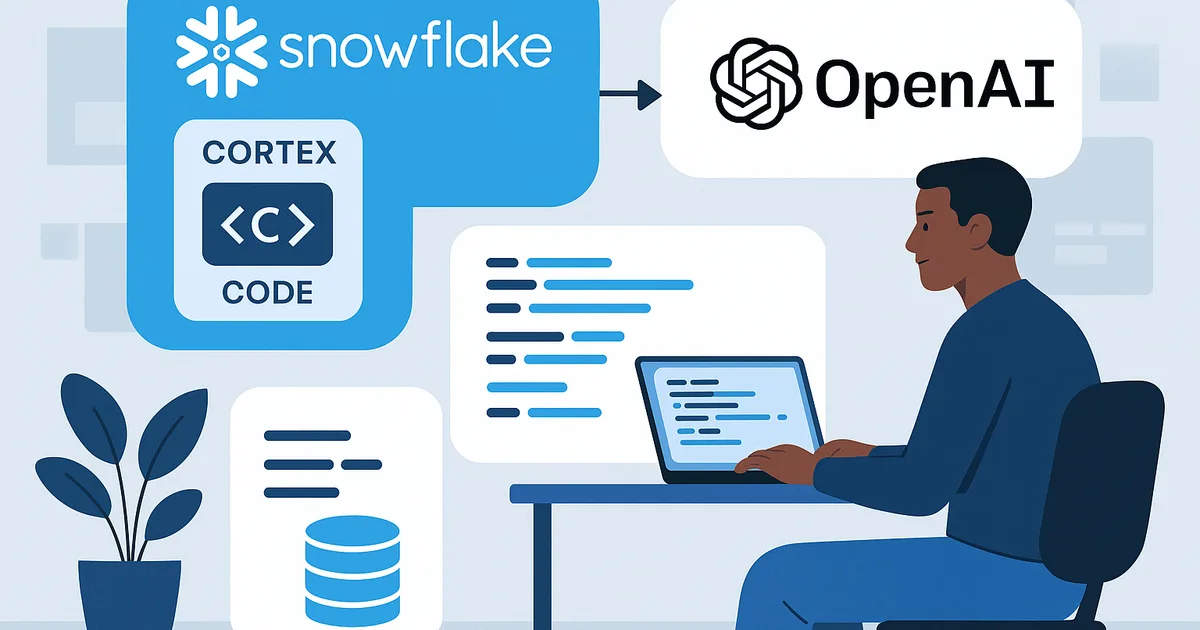
Snowflake's launch of Cortex Code and its partnership with OpenAI mark significant advancements in AI development, offering streamlined code generation and enhanced AI capabilities.

Get the daily AI & tech briefing.
Snowflake's Cortex Code: Revolutionizing AI Development
Snowflake's recent introduction of Cortex Code represents a significant leap in AI development tools. This agent-powered code generator is designed to simplify the creation of pipelines and applications by generating code that adheres to an enterprise's security and governance protocols. By automating these processes, Cortex Code reduces the manual effort required in coding, allowing developers to focus on more complex tasks. For instance, a data engineer can now use Cortex Code to automatically generate scripts for data transformation, ensuring consistency and compliance across the board. This innovation not only accelerates development timelines but also minimizes the risk of human error, leading to more robust and secure applications.
Semantic View Autopilot: Automating Semantic Modeling
Alongside Cortex Code, Snowflake unveiled the Semantic View Autopilot, an AI-driven service that automates the creation and management of semantic views. Semantic views are essential for providing context to data, enabling more accurate and meaningful analysis. Traditionally, developing these views required extensive manual effort and deep domain knowledge. With Semantic View Autopilot, organizations can automatically generate these views, ensuring that data is consistently interpreted across different departments. For example, a retail company can use this tool to create unified views of sales data, allowing marketing and finance teams to derive insights without discrepancies. This automation enhances data governance and ensures that decision-making is based on a single source of truth.
Snowflake Postgres Integration: Enhancing Data Management
In a strategic move to bolster its data management capabilities, Snowflake has integrated Snowflake Postgres into its AI Data Cloud. Acquired in June 2025, Snowflake Postgres is a PostgreSQL database that offers robust performance and scalability. By embedding this database natively, Snowflake eliminates the need for complex data pipelines, allowing for seamless data storage and retrieval. This integration is particularly beneficial for organizations dealing with large volumes of data, as it simplifies the architecture and reduces latency. For instance, an e-commerce platform can now manage its product catalog and customer data more efficiently, leading to faster query responses and improved user experiences.
OpenAI Partnership: Expanding AI Capabilities
Snowflake's $200 million partnership with OpenAI marks a significant expansion of its AI capabilities. This collaboration makes OpenAI's advanced models natively available within Snowflake's Cortex AI development environment. As a result, developers can leverage state-of-the-art AI models for tasks such as natural language processing, image recognition, and predictive analytics without leaving the Snowflake ecosystem. For example, a financial institution can use these models to detect fraudulent transactions by analyzing patterns in real-time data. This partnership not only enhances the functionality of Snowflake's platform but also provides users with access to cutting-edge AI tools, fostering innovation and competitive advantage.
Impact on the AI Development Landscape
The combination of Cortex Code, Semantic View Autopilot, Snowflake Postgres integration, and the OpenAI partnership positions Snowflake as a formidable player in the AI development landscape. These advancements address common challenges in AI development, such as code generation, data modeling, and integration of AI models. By providing tools that automate and streamline these processes, Snowflake empowers organizations to accelerate their AI initiatives. This holistic approach reduces the barriers to entry for AI development, enabling companies of various sizes to implement sophisticated AI solutions. Consequently, we can expect a surge in AI-driven applications across industries, from healthcare to retail, as organizations leverage these tools to gain insights and drive innovation.
Practical Takeaways for Organizations
Organizations looking to enhance their AI capabilities should consider the following practical takeaways from Snowflake's recent developments:
- Leverage Automated Code Generation: Utilize tools like Cortex Code to reduce manual coding efforts, ensuring consistency and compliance in application development.
- Implement AI-Driven Semantic Modeling: Adopt services like Semantic View Autopilot to automate the creation of semantic views, facilitating accurate data interpretation and analysis.
- Integrate Robust Databases: Take advantage of integrated databases like Snowflake Postgres to simplify data management and improve performance.
- Access Advanced AI Models: Through partnerships like that with OpenAI, incorporate cutting-edge AI models into your development environment to enhance application functionality.
By embracing these innovations, organizations can streamline their AI development processes, reduce time-to-market, and maintain a competitive edge in the rapidly evolving tech landscape.
Future Outlook: The Evolving Role of AI in Development
Looking ahead, the integration of AI into development tools is set to become more pervasive. Snowflake's recent initiatives exemplify a trend where AI is not just an add-on but a core component of development platforms. This evolution suggests a future where AI assists in every stage of the development lifecycle, from code generation to deployment. As AI models continue to advance, we can anticipate even more sophisticated tools that further reduce manual effort and enhance the quality of applications. Organizations that stay abreast of these developments and adapt accordingly will be well-positioned to harness the full potential of AI in their operations.
Conclusion
Snowflake's launch of Cortex Code, Semantic View Autopilot, Snowflake Postgres integration, and its partnership with OpenAI collectively represent a significant advancement in AI development tools. These innovations address key challenges in the development process, offering automated solutions that enhance efficiency, accuracy, and functionality. For organizations aiming to stay competitive in the digital age, adopting such tools is not just beneficial but essential. By leveraging these advancements, companies can accelerate their AI initiatives, drive innovation, and deliver superior products and services to their customers.
FAQ
What is Snowflake's Cortex Code?
Cortex Code is an agent-powered code generator introduced by Snowflake to automate the creation of pipelines and applications. It generates code that adheres to an enterprise's security and governance protocols, reducing manual coding efforts and minimizing errors.
How does Semantic View Autopilot benefit organizations?
Semantic View Autopilot is an AI-driven service that automates the creation and management of semantic views, ensuring consistent data interpretation across departments. This automation enhances data governance and facilitates accurate analysis.
What is the significance of integrating Snowflake Postgres?
Integrating Snowflake Postgres into Snowflake's AI Data Cloud eliminates the need for complex data pipelines, allowing for seamless data storage and retrieval. This integration simplifies data management and improves performance, especially for organizations handling large volumes of data.
How does the partnership with OpenAI enhance Snowflake's platform?
The $200 million partnership with OpenAI makes advanced AI models natively available within Snowflake's Cortex AI development environment. This collaboration enables developers to leverage state-of-the-art AI tools for various tasks, enhancing the functionality and innovation potential of Snowflake's platform.
What are the practical takeaways for organizations from these developments?
Organizations can benefit by leveraging automated code generation, implementing AI-driven semantic modeling, integrating robust databases, and accessing advanced AI models. These steps can streamline AI development processes, reduce time-to-market, and maintain a competitive edge in the tech landscape.
Related Articles



Don't miss what ships next
The daily briefing on AI & tech, straight to your inbox.
Written by
Vunsh MehtaI’m a computer science student and developer focused on AI, automation, and emerging tech. I write about AI news, tools, and trends from a practical, builder-focused perspective.