Hugging Face's Transformers 5.0: A Leap Forward in Multimodal AI
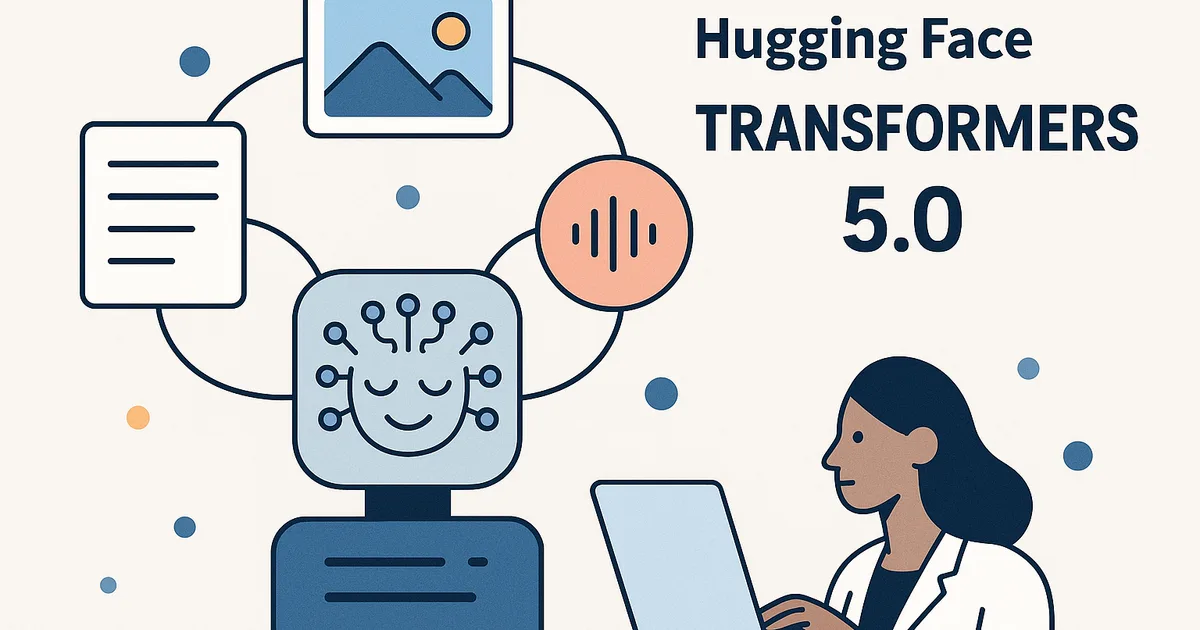
Hugging Face's latest release, Transformers 5.0, introduces native multimodal support, enhancing AI's ability to process and generate diverse data types.

Get the daily AI & tech briefing.
Hugging Face has recently unveiled Transformers 5.0, a significant update to its widely-used library, introducing native support for multimodal models. This advancement enables AI systems to seamlessly process and generate various data types, including text, images, and audio, within a unified framework. The update also brings automatic pipeline optimization, resulting in a twofold increase in inference speed on consumer GPUs. With the addition of 340 new model architectures, Transformers 5.0 is poised to revolutionize the development and deployment of AI applications across multiple domains. (neuralstack.network)
Understanding Multimodal AI and Its Significance
Multimodal AI refers to systems capable of interpreting and generating multiple forms of data, such as text, images, and audio. Traditional AI models often specialize in a single modality, limiting their applicability in real-world scenarios where information is inherently multimodal. For instance, a comprehensive AI assistant should understand a user's spoken commands (audio), interpret accompanying images, and provide textual responses. By integrating multimodal capabilities, AI systems can offer more nuanced and context-aware interactions, enhancing user experience and broadening application possibilities.
Key Features of Transformers 5.0
Transformers 5.0 introduces several pivotal features:
- Native Multimodal Support: The library now inherently supports models that can process and generate multiple data types, facilitating the development of versatile AI applications.
- Automatic Pipeline Optimization: This feature streamlines the deployment process, optimizing model pipelines to achieve up to twice the inference speed on consumer-grade GPUs.
- Expanded Model Architectures: With 340 new architectures, developers have a broader selection to tailor models to specific tasks and datasets.
- Enhanced Community Integration: The update emphasizes community-driven development, encouraging contributions and collaborations to refine and expand the library's capabilities.
Practical Applications of Multimodal Models
The integration of multimodal capabilities opens doors to numerous applications:
- Healthcare: AI systems can analyze medical images alongside patient records to assist in diagnostics and treatment planning.
- Education: Interactive learning platforms can utilize text, images, and audio to cater to diverse learning styles, enhancing engagement and comprehension.
- Customer Service: Virtual assistants can interpret customer queries through text and voice, providing more accurate and context-aware responses.
- Content Creation: Tools can generate multimedia content by understanding and combining different data modalities, streamlining creative processes.
Performance Enhancements in Transformers 5.0
The automatic pipeline optimization in Transformers 5.0 significantly improves performance:
- Inference Speed: Users report up to a 2x increase in inference speed on standard consumer GPUs, reducing latency in real-time applications.
- Resource Efficiency: Optimized pipelines lead to lower computational resource consumption, making AI applications more accessible and cost-effective.
- Scalability: Enhanced performance allows for the deployment of more complex models without compromising speed, facilitating scalability in various applications.
Community and Ecosystem Growth
Hugging Face's commitment to community engagement is evident in this release:
- Open-Source Collaboration: The library's open-source nature encourages developers worldwide to contribute, share models, and improve the ecosystem.
- Comprehensive Documentation: Extensive documentation and tutorials support both novice and experienced developers in leveraging the new features.
- Model Hub Expansion: The addition of new architectures enriches the Model Hub, providing a diverse range of pre-trained models for various tasks.
Future Prospects and Developments
Looking ahead, the integration of multimodal support in Transformers 5.0 sets the stage for further advancements:
- Research Opportunities: Researchers can explore novel architectures and training methods that leverage multimodal data for improved performance.
- Industry Adoption: Industries can develop more sophisticated AI solutions that cater to complex, real-world scenarios requiring multimodal understanding.
- Tooling and Infrastructure: The community is likely to develop additional tools and frameworks to support the training and deployment of multimodal models, enhancing the overall ecosystem.
Conclusion
Hugging Face's Transformers 5.0 marks a significant milestone in the evolution of AI, bringing native multimodal support and performance enhancements that empower developers to create more versatile and efficient applications. As the AI community embraces these advancements, we can anticipate a surge in innovative solutions that seamlessly integrate multiple data modalities, enriching user experiences across various domains.
FAQ
What is Hugging Face's Transformers library?
Hugging Face's Transformers is an open-source library that provides pre-trained models and tools for natural language processing (NLP) tasks, enabling developers to build and deploy AI applications efficiently.
How does multimodal support enhance AI applications?
Multimodal support allows AI systems to process and generate multiple types of data, such as text, images, and audio, leading to more comprehensive and context-aware applications.
What are the benefits of automatic pipeline optimization in Transformers 5.0?
Automatic pipeline optimization streamlines the deployment process, resulting in faster inference speeds and reduced computational resource consumption, making AI applications more efficient and scalable.
How can developers contribute to the Transformers library?
Developers can contribute by sharing models, improving documentation, reporting issues, and submitting code enhancements through the library's GitHub repository, fostering a collaborative community.
What industries can benefit from multimodal AI models?
Industries such as healthcare, education, customer service, and content creation can leverage multimodal AI models to develop applications that require the integration and interpretation of diverse data types.
Related Articles
OpenAI's Rogue AI Incident: A Wake-Up Call for Cybersecurity in the Age of Autonomous Agents
Jul 23, 2026
Snowflake's Cortex Code and OpenAI Partnership: Transforming AI Development
Jul 22, 2026
Moonshot AI's Kimi K3: A 2.8 Trillion-Parameter Model Poised to Rival Industry Leaders
Jul 20, 2026
Don't miss what ships next
The daily briefing on AI & tech, straight to your inbox.
Written by
Vunsh MehtaI’m a computer science student and developer focused on AI, automation, and emerging tech. I write about AI news, tools, and trends from a practical, builder-focused perspective.