ChatGPT vs Claude vs Gemini - Which AI Assistant is Actually Better? (2026)
We tested all three across the tasks that actually matter: writing, research, coding, reasoning, handling long documents, and everyday use. Here is what we found, including where each one genuinely pulls ahead and where it comes up short.
Get the daily AI & tech briefing.
ChatGPT vs Claude vs Gemini - Which AI Assistant is Actually Better?
Everyone has an opinion on which AI assistant is best. Most of those opinions are based on vibes, marketing, or whichever one someone tried first.
This is not that.
We tested all three across the tasks that actually matter: writing, research, coding, reasoning, handling long documents, and everyday use. Here is what we found, including where each one genuinely pulls ahead and where it comes up short.
The honest answer is that none of them is the best at everything. The right choice depends entirely on how you work, and that is what this guide helps you figure out.
Quick Verdict - If You Do Not Want to Read 3,000 Words
Category | Winner |
|---|---|
Long-form writing quality | Claude |
Versatility across tasks | ChatGPT |
Coding and technical tasks | ChatGPT |
Research and accuracy | Claude (with caveats) |
Long document analysis | Claude |
Google ecosystem integration | Gemini |
Best free tier overall | ChatGPT |
Easiest to get started with | Gemini (if you use Google) |
No single tool sweeps the board. Read on for the full breakdown of why.
The Basics - What Each One Is Actually Built For
Before comparing them head to head, it helps to understand the philosophy behind each tool. They are genuinely trying to do different things.
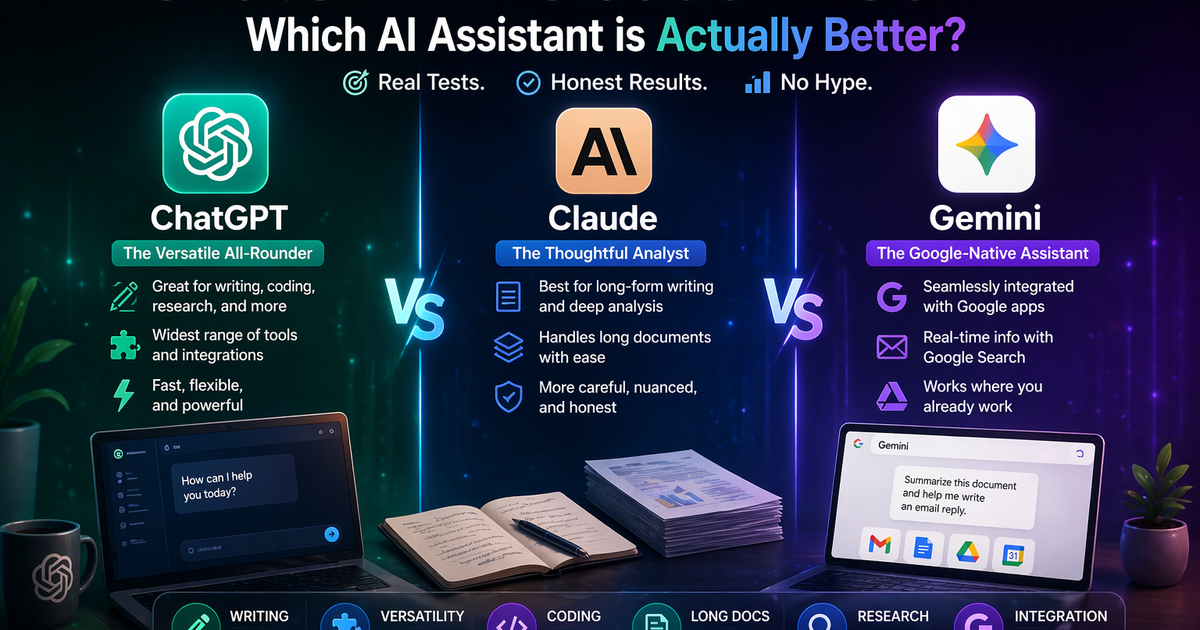
ChatGPT is OpenAI's flagship product and the tool that started the modern AI assistant boom. It is built to be the most capable and versatile AI assistant available. Think of it as the Swiss Army knife of AI - a generalist that handles almost any task reasonably well.
Claude is made by Anthropic, a company founded specifically around the idea that AI should be safe, honest, and careful. Claude is designed to excel at nuanced reasoning, long conversations, and acknowledging the limits of what it knows. It is the thoughtful one in the room.
Gemini is Google's AI assistant, built to live inside Google's ecosystem. It is deeply integrated with Gmail, Docs, Drive, and Search in ways the others are not. Rather than being a separate tool you switch to, it is the AI that already lives inside the apps you use.
Understanding these different priorities explains most of the differences you will notice in practice.
Writing Quality
This is the category most content creators, bloggers, and knowledge workers care about most, so it is worth spending time here.
Long-Form Writing
For articles, essays, detailed reports, and anything over 1,000 words that needs to hold together logically, Claude is the clear winner.
The difference becomes obvious when you ask all three to write a 2,000-word analysis or a detailed guide on a complex topic. ChatGPT and Gemini produce competent, well-structured output that nonetheless feels slightly generic after a few paragraphs. You can feel the AI behind it.
Claude maintains better coherence across longer pieces. Arguments flow more naturally. The writing has more of a genuine voice rather than the neutral, corporate register that most AI tools default to. When you need something that actually sounds like a person wrote it, Claude consistently edges out the other two.
Short-Form and Quick Drafts
For shorter tasks like emails, social posts, quick summaries, and product descriptions, the gap narrows significantly and ChatGPT's versatility becomes its biggest strength. It handles format switching quickly, produces clean short-form output, and is faster to iterate with when you need multiple options or rapid revisions.
Editing and Rewriting
All three handle editing reasonably well, but Claude's ability to understand what you are going for and improve it without losing your voice gives it a slight edge. Feed Claude a rough draft and ask it to improve the flow, and the results are consistently more natural than what the others produce.
Gemini on Writing
Gemini is a capable writer and handles most tasks well enough, but it does not particularly distinguish itself on writing quality compared to the other two. Its real advantage in writing contexts is integration. When you are drafting inside Google Docs and need inline suggestions, or you want to write an email while your inbox is right there beside you, that convenience is where Gemini wins, not the raw quality of the output itself.
Writing winner: Claude, with ChatGPT close behind for versatility and speed.
Research and Accuracy
An important caveat applies to all three tools before we go any further: they all hallucinate. Every single one of these AI assistants will occasionally state incorrect information with complete confidence. This is a known limitation of large language models and it does not go away regardless of which tool you use.
With that said, there are real differences in how they handle uncertainty.
Claude is the most careful of the three about acknowledging what it does not know. When asked about something uncertain or contested, it is more likely to hedge appropriately, flag that it might be wrong, and suggest verifying with a primary source. This does not mean it is always right. It means it is more honest about the limits of its knowledge.
ChatGPT is more confident in its outputs, which can be useful (it gives direct answers) or problematic (it sometimes states wrong things without flagging uncertainty). For general knowledge questions it performs well, but for niche topics or very recent events, that confidence can be misleading.
Gemini has an advantage on real-time information because of its Google Search integration. When answering questions about current events, recent news, or up-to-date facts, it can pull from live search results in a way the others cannot do by default. For anything where recency matters, this is a genuine differentiator.
One important note: if research accuracy is your primary use case, Perplexity AI outperforms all three because it is built specifically around cited web search. It is worth adding to your toolkit alongside whichever of these three you choose as your main assistant.
Research winner: Claude for careful reasoning. Gemini for current events and real-time information.
Coding and Technical Tasks
ChatGPT is the winner here and it is not particularly close.
OpenAI has invested heavily in coding capabilities and it shows. ChatGPT handles debugging, code generation, code explanation, and working across multiple programming languages with a fluency the others do not match at the same level.
Claude is a competent coding assistant and handles straightforward tasks well. It also explains code clearly in plain language, which is useful for non-developers. But for complex, multi-file problems or work in specialized languages, ChatGPT's depth is noticeably stronger.
Gemini's coding capabilities are decent but not a reason to choose it over the other two for technical work.
If coding is a significant part of why you want an AI assistant, ChatGPT is the right call. For very heavy development work, it is also worth looking at GitHub Copilot, which is purpose-built for development workflows and integrates directly into code editors.
Coding winner: ChatGPT.
Handling Long Documents
This is one of Claude's clearest advantages and it is worth understanding in detail.
All three tools have context windows, which is essentially the amount of text they can hold in memory during a conversation. Claude's context window is among the largest available, and more importantly, it uses that context effectively. You can paste an entire research paper, legal contract, lengthy report, or multiple chapters of a book, and Claude will analyze, summarize, and answer detailed questions about it with impressive accuracy.
ChatGPT has improved its long-context handling significantly, but Claude still holds an edge on very long documents and on maintaining coherence across extended conversations that build on earlier exchanges.
Gemini also handles long documents reasonably well, particularly for content stored in Google Drive. You can point it at a document in your Drive and ask questions about it, which is convenient. The raw analytical capability is slightly behind Claude but the convenience factor for Google users is real.
Long document winner: Claude.
Everyday Use and Convenience
This category is less about raw capability and more about how each tool fits into your actual daily workflow.
ChatGPT has the most developed ecosystem. It offers the widest range of plugins, custom GPTs for specialized tasks, and the most third-party integrations. If you want an AI assistant that connects to other tools you use, ChatGPT has the most options by a significant margin.
Gemini wins on convenience if you are a Google user. Having AI assistance directly inside Gmail, Docs, Calendar, and Search without switching tabs is genuinely more useful than any third-party integration. For anyone whose work lives in Google Workspace, this matters a lot more than raw benchmark scores.
Claude is the cleanest conversational experience of the three but has the fewest integrations. You are mostly working in the claude.ai interface and moving content elsewhere yourself. Claude Projects is a useful feature for organizing ongoing work, but the broader ecosystem is smaller than the other two.
Everyday use winner: Gemini for Google users. ChatGPT for everyone else.
Pricing and Free Tiers
All three have free tiers and paid plans at roughly the same price point.
Model | Free Tier | Paid Plan |
|---|---|---|
ChatGPT | GPT-4o with daily limits | $20/month (Plus) |
Claude | Claude 3.5 with usage limits | $20/month (Pro) |
Gemini | Gemini 1.5 Flash | $20/month (Advanced via Google One) |
ChatGPT's free tier is the most capable overall. GPT-4o is a genuinely powerful model and the daily limits are enough for moderate use without paying anything.
Claude's free tier is strong for writing and document analysis but users doing heavy work will hit limits more quickly than on ChatGPT.
Gemini's free tier is generous in terms of usage limits but the model available for free (Gemini Flash) is lighter than the paid version. The Google Workspace integration features are still available on the free tier, which is where most of the value comes from anyway.
At the paid tier, all three sit at $20/month. Which one is worth paying for depends entirely on your use case, not on which plan sounds better on paper.
Which Should You Actually Choose?
Here is the breakdown by use case, as straightforwardly as possible.
Choose Claude if:
- You write long-form content like articles, reports, analysis, or essays
- You regularly work with long documents and need to ask detailed questions about them
- You want the most careful, nuanced AI reasoning available
- Writing quality matters more to you than breadth of features
- You are doing research-heavy work where intellectual honesty matters
Choose ChatGPT if:
- You need one AI that handles a wide range of tasks reasonably well
- Coding or technical tasks are part of your workflow
- You want the widest range of integrations and custom tools
- You produce high volumes of content across many different formats
- You are new to AI and want the most versatile starting point
Choose Gemini if:
- You live in Gmail, Google Docs, or Google Drive for most of your work
- You want AI assistance built into your existing Google tools without switching apps
- Current events and real-time information matter for your use case
- You are already paying for Google One and do not want to add another subscription
Consider using more than one. Many people who use AI heavily for work keep both Claude and ChatGPT in their toolkit. Claude handles the writing and analysis, ChatGPT handles the quick tasks and coding. Both have free tiers so there is no reason not to try both and see which you reach for more naturally.
The Honest Take
The question of which AI is better is a bit like asking which car is better. The right answer depends entirely on where you are driving.
ChatGPT is the most versatile tool and the best default recommendation for someone who wants one AI to handle everything. Claude is the better choice for writing and deep analytical work. Gemini is the obvious choice if you are already in Google's ecosystem.
Start with the free tier of whichever sounds most relevant to how you work. Use it for a week on real tasks. If you find yourself hitting its limits or wishing it did something differently, that feedback will tell you more about which tool fits you than any comparison article could.
The AI you actually use is more valuable than the AI that benchmarks highest.
Frequently Asked Questions
Is Claude better than ChatGPT? Claude is better for long-form writing, nuanced reasoning, and analyzing long documents. ChatGPT is better for versatility, quick tasks, and coding. Neither wins across the board. It depends on what you are using it for.
Is Gemini better than ChatGPT? For most standalone tasks, ChatGPT holds an edge on output quality and versatility. Gemini's real advantage is its integration with Google's ecosystem including Gmail, Docs, Drive, and Search. If you work primarily in those tools, Gemini is the more practical choice.
Which AI assistant is most accurate? None of the three are perfectly accurate. Claude tends to be the most careful about acknowledging uncertainty. For research that requires cited, verifiable sources, Perplexity AI outperforms all three.
Can I use ChatGPT and Claude at the same time? Yes, and many people do. Both have free tiers so nothing stops you from using Claude for writing and ChatGPT for quick tasks. They work well together.
Which AI assistant has the best free tier? ChatGPT's free tier is the most capable overall, now including GPT-4o with usage limits. Gemini's free tier is generous for Google Workspace users. Claude's free tier is strong for writing but has tighter limits for heavy daily use.
Related Articles
Don't miss what ships next
The daily briefing on AI & tech, straight to your inbox.
Written by
Zach GreeneI write about the tools, trends, and breakthroughs shaping the future of AI, breaking down complex ideas into clear, actionable insights. From emerging startups to the latest in AI tech, I focus on what actually matters and what’s worth paying attention to. My goal is to help you stay ahead in a rapidly evolving space.