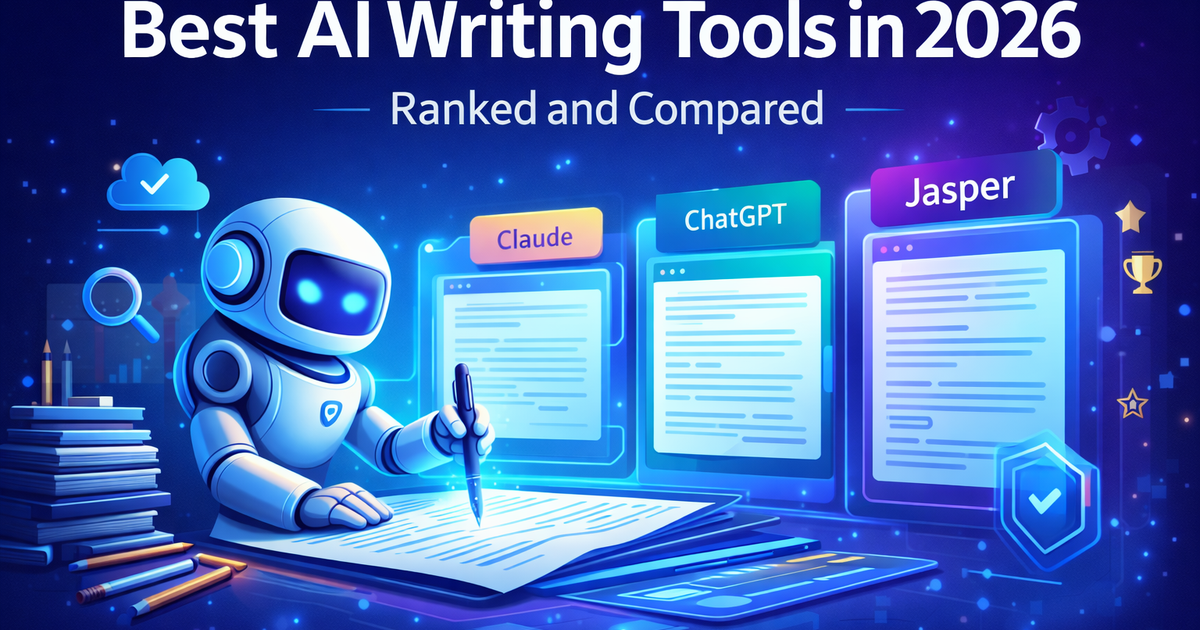
Best AI Writing Tools in 2026 - Ranked and Compared
There are more AI writing tools than ever in 2026. Most of them are fine. A handful are genuinely great. And a few are not worth your time or money no matter how good their marketing looks.
Get the daily AI & tech briefing.
Best AI Writing Tools in 2026 - Ranked and Compared
There are more AI writing tools than ever in 2026. Most of them are fine. A handful are genuinely great. And a few are not worth your time or money no matter how good their marketing looks.
We spent several weeks putting the most talked-about options through real writing tasks — not just blog posts, but long-form articles, product descriptions, email sequences, and SEO content. Here's what we actually found.
What We Tested For
Before getting into the rankings, here's what actually matters when evaluating an AI writing tool for real content work:
Output quality — Does it produce writing you'd actually publish, or does it need so much editing that you've saved no time at all?
Voice consistency — Can it maintain a consistent tone across a long piece, or does it drift into generic AI-speak by paragraph three?
SEO awareness — Does it understand how to structure content for search, or does it just produce walls of text?
Speed — How quickly does it generate usable output? Some tools are fast and rough, others are slow and polished.
Price vs value — What do you actually get for the money compared to alternatives?
With that framework in mind, here's how the main players stack up.
The Best AI Writing Tools in 2026
1. Claude - Best for Long-Form, Nuanced Writing
Claude has quietly become the go-to for writers who care about quality over speed. Where most AI tools produce competent but flat prose, Claude has a noticeably stronger grasp of nuance, tone, and structure in longer pieces.
It's particularly strong at:
- Long-form articles and guides (2,000+ words) that need to hold together logically
- Content that requires careful reasoning or balanced takes on complex topics
- Editing and rewriting — feed it a rough draft and ask for improvements, the results are consistently strong
- Maintaining a conversational voice without slipping into the generic AI register
The free tier is capable enough to evaluate whether it fits your workflow. The Pro plan at $20/month gives you significantly more usage and access to the most capable models.
Where it falls short: Claude doesn't have built-in SEO tooling or integrations with content management systems. You're working in a chat interface and moving content elsewhere yourself. Also no image generation — it's purely text.
Best for: Bloggers, journalists, and content creators who prioritize quality and write longer pieces where voice and coherence matter.
Pricing: Free tier available. Pro plan $20/month.
2. ChatGPT - Best All-Rounder
If Claude is the thoughtful writer, ChatGPT is the extremely capable generalist. It's faster to iterate with, handles a wider range of task types, and has the most developed ecosystem of integrations and custom tools.
For writing specifically, GPT-4o (included in the free tier with limits) produces strong first drafts across almost every format — blog posts, social content, email campaigns, product descriptions, ad copy. The breadth is its biggest advantage.
It's particularly strong at:
- High-volume content production where speed matters
- Switching between formats quickly in the same session
- Using custom instructions and memory to maintain your voice over time
- Coding and technical writing alongside regular content
Where it falls short: Long-form, high-nuance writing — deep analysis pieces, opinion essays, content that requires holding a complex argument together across many sections — is where Claude tends to pull ahead. ChatGPT's output can also feel more formulaic on first draft compared to Claude's.
Best for: Content creators who need versatility across many formats, or anyone producing high volumes of shorter content.
Pricing: Free tier available. Plus plan $20/month.
3. Jasper - Best for SEO Content at Scale
Jasper is the most purpose-built tool on this list for content marketing teams and SEO-focused creators. It's not trying to be a general AI assistant — it's designed specifically around the content production workflow.
The standout features that justify the higher price:
- Built-in SEO mode that integrates with tools like Surfer SEO
- Brand voice settings that remember your tone, style, and terminology across all content
- Templates for every content format (blog posts, product descriptions, ad copy, email sequences)
- Team collaboration features for agencies and content teams
Where it falls short: For solo creators, the price is hard to justify against Claude or ChatGPT at $20/month. Jasper's entry plan is significantly more expensive, and the quality gap isn't always worth the premium unless you're using the SEO and team features heavily.
Best for: Content marketing teams, SEO agencies, and creators producing high volumes of optimized content who need brand consistency across multiple writers.
Pricing: Creator plan starts around $49/month. Team plans from $125/month.
4. Writesonic - Best Budget Option
Writesonic punches above its price point. The output quality on blog posts and articles is genuinely competitive with tools that cost more, and its free tier is generous enough to give you a real sense of whether it fits your workflow.
Key strengths:
- Chatsonic (its AI assistant) has web browsing built in for real-time information
- Article writer produces structured long-form content faster than most competitors
- Solid SEO article writing features at a lower price than Jasper
- Good template library for common content formats
Where it falls short: The writing can feel slightly more generic than Claude or ChatGPT at their best. For content that needs a strong, distinctive voice, you'll find yourself editing more. Customer support also lags behind the bigger players.
Best for: New bloggers, solo creators on a budget, or anyone who wants to test AI writing at low cost before committing to a pricier tool.
Pricing: Free tier available. Individual plan around $20/month. Business plans from $40/month.
5. Copy.ai - Best for Short-Form Content
Copy.ai started as a tool for marketing copy — taglines, ad headlines, email subject lines — and that's still where it excels. If short-form content is a significant part of your workflow alongside blogging, it's worth having in your stack.
Key strengths:
- Excellent at marketing copy, CTAs, email subject lines, and social posts
- Workflows feature lets you automate repetitive content tasks
- Clean, simple interface that's easy to get started with
- Decent free tier
Where it falls short: Long-form blog content isn't its strongest suit. For full articles, the output requires more editing than Claude or ChatGPT. It's best as a complement to a primary writing tool rather than a standalone solution for bloggers.
Best for: Content creators who also manage email campaigns, social media, or marketing copy alongside their blog content.
Pricing: Free tier available. Starter plan around $49/month.
6. Notion AI - Best for Writers Already in Notion
If Notion is already your writing and notes home base, the AI add-on is worth enabling. It's tightly integrated into the editor, which means no copy-pasting between tools — you just highlight text, ask for improvements, and keep writing.
Key strengths:
- Completely integrated into your existing Notion workspace
- Great for editing, summarizing, and restructuring content you've already drafted
- AI search across your notes and documents
- Feels natural if Notion is already your workflow
Where it falls short: As a standalone AI writing tool, it's not competitive with Claude or ChatGPT on raw output quality. It's a convenience add-on, not a replacement for a dedicated AI writing tool. Also requires paying for Notion itself.
Best for: Existing Notion users who want AI assistance without switching to a separate tool.
Pricing: AI add-on around $10/month per member on top of existing Notion plan.
Quick Comparison Table
Tool | Best For | Starting Price | Free Tier |
|---|---|---|---|
Claude | Long-form quality writing | $20/mo | Yes |
ChatGPT | Versatility across all formats | $20/mo | Yes |
Jasper | SEO content teams | $49/mo | No |
Writesonic | Budget-conscious creators | $20/mo | Yes |
Copy.ai | Short-form and marketing copy | $49/mo | Yes |
Notion AI | Existing Notion users | +$10/mo | No |
Which AI Writing Tool Should You Actually Use?
If you're a solo blogger focused on quality: Start with Claude. The free tier is capable enough to publish from, and the Pro plan at $20/month is the best value for serious long-form writers.
If you need to produce a lot of different content types quickly: ChatGPT is your best all-rounder. The free tier with GPT-4o handles most tasks, and Plus gives you more capacity when you need it.
If SEO is your primary goal and you have a budget: Jasper's SEO integrations and brand voice features are worth the premium if you're running a content marketing operation rather than a solo blog.
If you're just starting out and want to test AI writing cheaply: Writesonic's free tier and low entry price makes it the most accessible starting point.
If you're a Notion user: Enable Notion AI for the convenience, but pair it with Claude or ChatGPT for serious writing tasks.
The Bottom Line
The best AI writing tool is the one that fits how you actually work. For most solo content creators in 2026, that's Claude for quality-first writing or ChatGPT for versatility — both at $20/month with free tiers worth trying first.
The expensive tools (Jasper, Copy.ai) are hard to justify unless you're running a team or a high-volume content operation where their specific features directly solve a real workflow problem.
Start with free tiers. See what clicks. Then commit.
Frequently Asked Questions
What is the best AI writing tool in 2026? Claude is the strongest for long-form, nuanced content. ChatGPT is the best all-rounder. The right choice depends on your writing style, volume, and budget — see the full breakdown above.
Are AI writing tools worth paying for? For most content creators, yes. A $20/month subscription typically saves 5-10 hours of writing time per week. The productivity gains compound quickly once you've built AI into your workflow.
Will Google penalize AI-written content? Google evaluates content quality, not how it was produced. Helpful, well-structured, accurate content ranks well regardless of whether AI was involved. Thin, repetitive, low-effort content gets filtered out whether it's AI-written or not.
What is the cheapest AI writing tool worth using? Writesonic offers the best quality at the budget end. ChatGPT's free tier is also genuinely capable for basic writing tasks.
Can AI writing tools replace human writers? Not entirely. AI tools handle the heavy lifting of drafting and structuring content well, but they lack genuine personal experience, original research, and distinctive voice. The best results come from treating AI as a writing partner rather than a replacement.
Related Articles



Don't miss what ships next
The daily briefing on AI & tech, straight to your inbox.
Written by
Zach GreeneI write about the tools, trends, and breakthroughs shaping the future of AI, breaking down complex ideas into clear, actionable insights. From emerging startups to the latest in AI tech, I focus on what actually matters and what’s worth paying attention to. My goal is to help you stay ahead in a rapidly evolving space.